
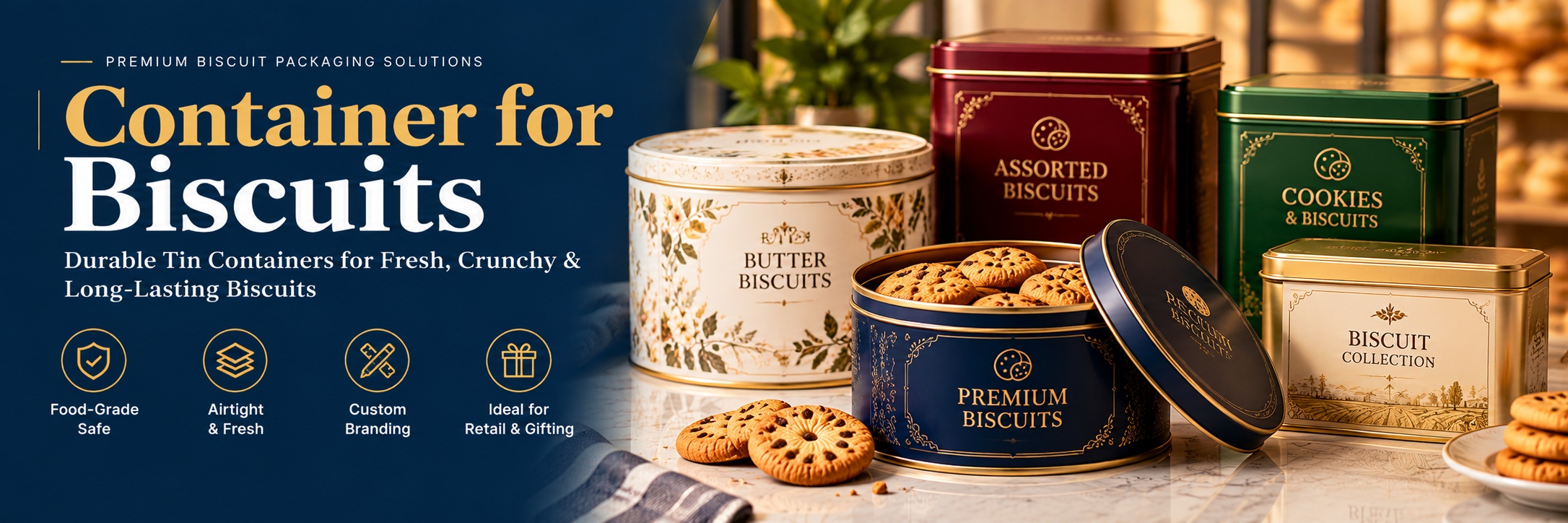
Container for Biscuits: Choosing the Right Tin Packaging for Your Brand
container for biscuits is an important packaging choice for bakeries, biscuit manufacturers and food brands that want to protect product presentation while building a recognisable identity. Choosing the right container for biscuits starts with the biscuit itself: its size, texture, fragility, packing method and route to the customer.
Whether you are launching a new cookie range or upgrading an established bakery line, this guide covers the practical decisions to make before ordering.
Why biscuit packaging matters
A well-selected container for biscuits does more than hold a product. It protects presentation, supports careful handling and gives a bakery or food brand a surface to communicate its identity. Customers notice the pack before they taste what is inside, so shape, finish and ease of opening all contribute to the experience.
Biscuits vary widely. Some are crisp and thin, some are thick cookies, and others are filled, coated or decorated. Each type has different dimensions and handling needs. Choose packaging around the actual product, the number of pieces per pack, the packing process and the journey from production to the customer.
Metal tins are often considered for premium presentation because they can feel substantial and may be reused after the biscuits are finished. However, material, coating, liner and closure suitability must be checked for the intended product and packing method.
1. Match the format to the biscuit
Start with the biscuit itself. Measure its length, width, height and, where relevant, the diameter. Note whether the product is fragile, decorated or likely to crumble. Share these measurements with the packaging supplier instead of estimating from a photograph.
A container for biscuits should hold the product securely without squeezing it. Too much empty space can allow pieces to move during transport; too little space can make filling difficult or damage delicate edges. Test the actual biscuits in a sample pack and check how easily customers can remove them.
For assorted biscuits, consider a tray, divider or separate inner pouch to keep varieties organised. If the biscuits have different flavours or textures, discuss whether they should be separated to prevent flavour transfer or breakage.
2. Select the right shape and size
Round tins are commonly suited to cookies, butter biscuits and assorted collections. Rectangular formats can work well for long biscuits or neat rows and may use shelf space efficiently. Square tins can give a compact contemporary look, while shallow formats may suit thin biscuits and premium assortments.
Do not choose a tin based only on its outside measurements. Ask for the usable internal dimensions and check the lid overlap. The best container for biscuits is the one that accommodates the planned count, allows practical packing and avoids unnecessary unused volume.
Ask whether a standard size is available before developing a fully custom shape. Standard formats can sometimes simplify sampling, production planning and repeat orders. If a custom design is important, confirm tooling costs, minimum order quantity and lead time at the start.
3. Consider metal tins for premium presentation
Metal packaging can help a biscuit range look distinctive on a retail shelf or in a gift hamper. A durable decorative tin may also have a second life as household storage, keeping the brand visible after the food has been consumed.
A custom container for biscuits can be developed in different shapes, sizes and printed finishes. The supplier should explain the proposed metal specification, thickness, construction and internal finish. Do not assume that every metal tin is automatically suitable for direct food contact.
If biscuits touch the inside surface, confirm the suitability of the internal coating or liner for the specific food and storage conditions. If the product is first packed in a sealed pouch, explain that arrangement to the manufacturer so the packaging specification reflects the actual use.
4. Review the lid and freshness requirements
The lid should be straightforward to open and should remain secure during ordinary handling. Depending on the design, a tin may use a slip lid, friction-fit lid or another closure. Ask for a sample and check both opening effort and how securely the lid sits after repeated use.
A decorative tin by itself should not be treated as an airtight freshness barrier. If the biscuit needs protection from moisture, oxygen or aroma transfer, discuss a suitable inner pouch, seal or liner with a food-packaging specialist. Shelf-life performance should be validated for the actual product and storage conditions.
Consider how filled tins will be stacked, stored and transported. A container for biscuits should be assessed as part of the complete pack, including any inner wrap and the outer shipping carton. If courier delivery is planned, test the packed product under realistic handling conditions.
5. Make the artwork work for your brand
Use a clear brand identity and make the biscuit variety easy to recognise. The logo, product name and a visual cue such as a flavour or product illustration can help customers understand the pack quickly. Premium gifting tins may use restrained colours and metallic accents; everyday retail tins may need a simple design that can be repeated across multiple flavours.
Before approving artwork for a printed container for biscuits, confirm the printable area, seam positions, safe margins, colour references and areas that may be hidden by the lid. Ask for a production-style proof or physical sample where possible. Check that small text remains readable at the final size.
Plan product information and applicable declarations as part of the packaging artwork. Depending on the market and sales channel, details may include ingredients, allergen information, net quantity, manufacturer details, batch information and other required declarations. Verify current labelling requirements with a qualified compliance professional.
6. Compare cost and order quantities
Request quotations using the same specification so supplier prices can be compared fairly. Ask for separate details covering the tin body, lid, printing, finishing, tooling where applicable, packing and freight. Confirm whether sample charges are refundable or adjusted against a bulk order.
The cost of a container for biscuits can change with dimensions, material specification, printing coverage, finish, quantity and custom tooling. A standard tin with customised artwork may be a practical starting point for a new brand, while a fully custom format may be justified for a larger premium range.
Discuss reorder planning before confirming the first order. Ask whether the supplier can retain the approved artwork and specification, how long repeat production normally takes and whether the same finish can be reproduced consistently. Seasonal demand should be included in the production calendar.
7. Approve a sample before bulk production
A sample review helps catch issues before a large order is made. Fill the proposed container for biscuits with the actual product and check the fit, loading process, removal experience and overall presentation. If an inner pouch is part of the design, test the pouch and tin together.
Inspect the lid fit, seams, edges, print quality and surface finish. Stack filled samples in the way your team expects to store or ship them. If the product will travel by courier, use the intended outer carton and suitable protective materials for a transit test.
Once the sample is approved, keep a written specification covering internal and external dimensions, material, finish, artwork version, closure, inner packaging arrangement, quantity and delivery expectations. Retaining an approved reference sample makes later quality checks easier.
Packaging ideas for bakeries, gifting businesses and food brands
Independent bakeries can use small tins for signature cookies, butter biscuits, seasonal assortments and limited-edition collections. A family of coordinated sizes can support different price points while maintaining a consistent look across the range.
Corporate gifting businesses may choose decorative tins for assorted biscuits presented to clients, employees or event guests. In this situation, the container for biscuits becomes part of the gift, so print quality, finish and presentation deserve particular attention. Consider whether the shape and construction are practical for reuse.
Food manufacturers and distributors may prioritise standard dimensions, repeat supply, efficient carton planning and dependable lead times. Their ideal packaging choice balances appearance with practical production and logistics requirements.
What to include in a supplier enquiry
Share the biscuit type, approximate dimensions, pieces per pack, preferred tin shape, target quantity and expected order schedule. Explain whether biscuits will be packed directly into the tin or placed in an inner pouch first. Include artwork or reference images if available, but confirm that final dimensions and construction must be approved through a sample.
Ask the supplier to state internal and external dimensions, material details, available finishes, printing method, closure type, minimum order quantity, sample charges, production timeline and delivery terms. If food contact is relevant, request the appropriate material and coating information for review.
A clear brief helps the manufacturer recommend a container for biscuits that fits both the product and the business plan. It also reduces avoidable revisions after artwork approval or production begins.
Quick supplier checklist
- Biscuit type, dimensions and pieces per pack are documented.
- Internal dimensions and closure have been checked using a sample.
- Material and internal coating or liner suitability are confirmed for the intended use.
- Inner pouch or seal requirements have been discussed where freshness protection is needed.
- Artwork, print area, colours and finishing have been approved.
- MOQ, tooling, sample cost, production time and freight are stated in the quotation.
- A written specification and approved reference sample are retained.
Choose a container for biscuits only after checking the real product dimensions.
A container for biscuits should suit the number of pieces in each retail pack.
Test a container for biscuits with the actual batch, not a sample-sized substitute.
The right container for biscuits should make filling simple for the bakery team.
Review how a container for biscuits fits inside the shipping carton.
A container for biscuits for gifting may need a more decorative finish.
For daily retail sales, a container for biscuits should support efficient shelf display.
Compare each container for biscuits by usable internal space rather than outside size.
A reusable container for biscuits can add value to a premium gifting experience.
Ask whether the container for biscuits needs a separate inner pouch.
The container for biscuits should be checked for lid fit before bulk production.
Printed artwork can help a container for biscuits stand out on the shelf.
Keep product information readable on the container for biscuits or its inner pack.
Select a container for biscuits that matches the fragility of the product.
An assorted range may need a container for biscuits with dividers or trays.
Confirm the coating specification for any container for biscuits used in food packing.
A container for biscuits should be evaluated with its complete packing system.
Measure the biscuit stack before finalising a container for biscuits.
Check whether a standard container for biscuits can meet your required quantity.
A custom container for biscuits may need additional sampling and tooling time.
Agree on the finish and dimensions of the container for biscuits in writing.
Retain an approved sample of the container for biscuits for repeat orders.
Plan seasonal orders early if the container for biscuits needs custom printing.
Compare freight and storage costs alongside the unit price of a container for biscuits.
The supplier should confirm the intended use of the container for biscuits.
Check that the container for biscuits opens easily without loosening during transport.
A container for biscuits should protect presentation without making packing unnecessarily slow.
Consider the display, delivery and reuse of the container for biscuits.
Use actual product testing to validate the chosen container for biscuits.
Document the final artwork and material details for every container for biscuits order.
Frequently asked questions
What is the best container for biscuits?
The best choice depends on biscuit size, fragility, packing method, storage conditions and brand positioning. Metal tins can suit premium and reusable packaging, but the material and internal finish must be verified for the intended use.
Are metal tins suitable for biscuits?
They can be suitable when the metal specification, coating or liner, closure and product-contact arrangement are appropriate. Confirm suitability with the manufacturer and a qualified food-packaging professional.
Should biscuits go directly inside a tin?
That depends on verified food-contact suitability and freshness requirements. Some brands use an inner pouch or seal inside the tin for an additional barrier.
Can biscuit tins be custom printed?
Many tin formats support custom artwork and finishes. Confirm printable areas, artwork requirements, minimum quantities and sample approval with the supplier.
How do I choose the right size?
Measure the biscuits and decide the count per pack. Check internal dimensions and test the actual product in a sample before bulk production.
What should I check before ordering?
Review dimensions, material, closure, print quality, inner packaging, minimum quantity, lead time, delivery terms and a written approved specification.
Discuss your biscuit tin packaging requirements
Looking for a suitable container for biscuits for your bakery, food brand or gifting range? Share your product dimensions, quantity and design preferences with JS Tin Containers to discuss available tin packaging options and customisation requirements.
Contact JS Tin Containers to discuss your requirement.
Follow JS Tin Containers on Instagram for packaging ideas, product updates and brand inspiration.