
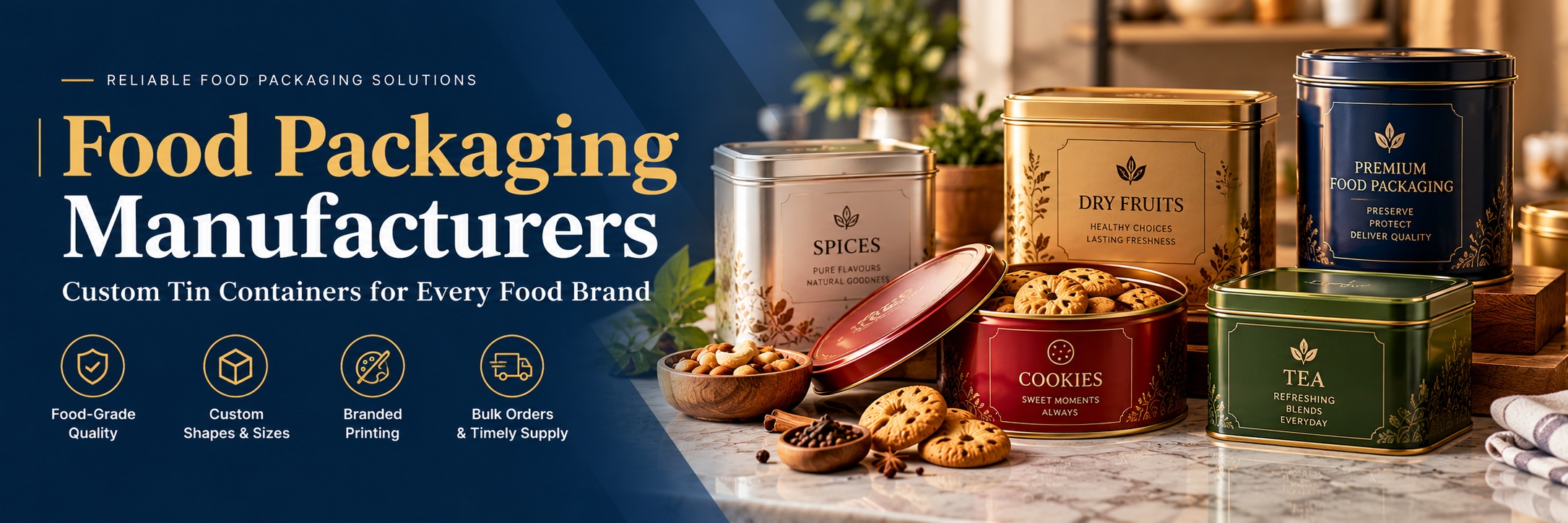
food packaging manufacturers: 7 Essential Things to Check Before You Order
food packaging manufacturers play an important role in how a product is protected, presented, stored and delivered. Whether you sell biscuits, cookies, tea, coffee, spices, dry fruits or confectionery, selecting the right packaging partner requires more than comparing prices.
This guide explains what to review when shortlisting suppliers, how to assess custom metal tin packaging, which questions to ask before a bulk order and how to prepare a clear enquiry for JS Tin Containers.
What to Look for When Comparing Food Packaging Manufacturers
Choosing between food packaging manufacturers starts with understanding the product, not simply comparing a quoted unit price. A suitable packaging partner should be able to discuss the food type, pack dimensions, closure, printing, order quantity and delivery schedule. For a brand evaluating food packaging manufacturers, clear answers at the enquiry stage can prevent avoidable changes after production begins.
Ask whether the supplier makes the packaging in-house or sources it from another party. This distinction can affect communication, sampling, production control and lead times. Food packaging manufacturers should be able to explain the stages they handle and identify any processes completed by approved vendors.
Request details about material specifications and food-contact suitability for the intended application. Packaging requirements vary according to the food, its moisture and oil content, storage temperature, expected shelf life and distribution conditions. Do not assume that every metal tin or coating is appropriate for every food product.
Why Metal Tins Are Considered for Selected Food Products
Metal tins offer a firm outer structure and a distinctive surface for branding. Depending on the design and closure, they can be considered for dry products such as biscuits, cookies, tea, coffee, spices, dry fruits, nuts and confectionery. Businesses comparing food packaging manufacturers may include tins in their packaging review when shelf presentation, gifting and post-use reuse are relevant.
A tin can be designed around a product range, seasonal collection or premium gift assortment. Printed artwork, colour choices, surface finishes and decorative details help create a recognisable presentation. Food packaging manufacturers with metal-packaging experience can discuss which design features are practical for the required quantity and budget.
The tin is only one part of the complete pack. Depending on the product, brands may need a food-safe inner pouch, liner, seal or other barrier system. The correct combination should be determined through product and packaging testing rather than appearance alone.
Food Packaging Formats for Different Product Categories
Biscuits and cookies may be packed in round, square or rectangular tins, depending on product dimensions and how the pieces are arranged. A wide opening can make access easier, while internal trays or dividers may help separate assortments. When discussing options with food packaging manufacturers, share the actual biscuit size and the number of pieces planned per pack.
Tea, coffee and spice products often need attention to aroma, moisture and light exposure. The tin design, lid fit and any inner barrier should be evaluated together. Ask food packaging manufacturers what closure and liner options are available, and validate the final pack with the product before placing a large order.
Dry fruits and nuts are frequently presented in gift tins and assorted collections. Compartments can organise different varieties, while a fitted inner pouch may be appropriate for product protection. For confectionery and chocolates, consider product shape, surface sensitivity, temperature exposure and the way the pack will be transported.
Bakery businesses may use tins for cookies, rusks, tea cakes or special seasonal assortments. A carefully sized container can reduce unnecessary movement inside the pack. Food packaging manufacturers should be given the product dimensions and a sample whenever possible so that capacity and fit can be assessed accurately.
Custom Tin Packaging: Shape, Size and Printing
Start with the product dimensions and the quantity that needs to fit inside the container. Avoid selecting a tin based only on its external appearance. Allow for the product arrangement, any inner packaging and enough practical clearance for packing and removal. Food packaging manufacturers can use these details to recommend a suitable format for sampling.
Common design decisions include round or rectangular bodies, height, lid style, opening method, corner construction and surface finish. Not every shape is available at every quantity, so ask about tooling, minimum order quantities and any additional setup charges before approving a design.
Artwork should be prepared with the actual printable area and production method in mind. Supply a high-resolution logo, brand colours, product name and required text. Ask food packaging manufacturers for a print-ready template or dieline, and check spelling, colour references, alignment and legal product information before giving final approval.
A physical sample or pre-production proof is valuable. Review the lid fit, edges, finish, print quality, dimensions and overall handling. If the product is intended for food contact, confirm the relevant material and coating documentation for the proposed application. Keep an approved sample as a reference for repeat orders.
Questions to Ask Before Placing a Bulk Order
Before choosing food packaging manufacturers, ask for a written quotation that identifies the material, dimensions, thickness or specification where relevant, printing method, finish, packing method, quantity, taxes, freight and expected dispatch date. A clear quotation makes it easier to compare like with like.
Confirm the minimum order quantity and whether different sizes or artwork versions can be combined. Ask how sample costs, tooling charges and repeat-order pricing are handled. If your business needs a phased delivery, discuss whether production and dispatch can be scheduled in batches.
Clarify how defects, transit damage and quantity differences are reported and resolved. Ask how finished tins are packed for transport and whether cartons are labelled by size or design. Food packaging manufacturers should provide a clear point of contact for order updates and issue resolution.
Finally, ask what information the supplier needs from you to begin. Product samples, dimensions, artwork, quantity, delivery location and target date are useful starting points. Sharing complete information helps the supplier provide a more realistic proposal.
How JS Tin Containers Supports Packaging Enquiries
JS Tin Containers works with businesses exploring metal tin packaging for suitable food and product categories. If you are comparing food packaging manufacturers for a custom tin requirement, share the product type, preferred shape, approximate dimensions, quantity and branding needs so the team can understand the scope of your enquiry.
The discussion can cover tin formats for cookies, biscuits, tea, coffee, spices, dry fruits, nuts and confectionery, subject to product suitability and manufacturing feasibility. Businesses can also discuss printed branding, finishing preferences and sample requirements before moving towards a bulk order.
A good enquiry is specific. Include photographs or physical samples of the product, the number of units required, the preferred delivery location and any deadline. If you already have a reference tin, share its dimensions and details. This helps food packaging manufacturers assess the requirement more accurately and reduces unnecessary back-and-forth.
Packaging suitability must always be checked against the product and applicable food-contact requirements. Confirm the final material, inner barrier, closure and storage conditions before approving production. Do not rely on a visual sample alone as proof of food safety or shelf-life performance.
A Practical Checklist Before You Confirm the Supplier
Use this checklist when reviewing food packaging manufacturers and comparing proposals:
- Product category, dimensions and sample availability
- Material specification and suitability for the intended food application
- Closure, liner or inner packaging requirements
- Available shapes, sizes, printing and finishing options
- Minimum order quantity, sample cost and tooling charges
- Written quotation, taxes, freight and delivery schedule
- Quality checks, transit packing and issue-resolution process
Use the same checklist for every supplier so that your comparison is based on the same requirements. The most useful proposal is one that clearly explains what is included, what needs confirmation and what could affect the final cost or timeline.
How to Make Your First Packaging Enquiry Useful
When you contact food packaging manufacturers, provide enough information for an informed first response. Mention the food product, whether it is dry or has special storage needs, the approximate pack size, quantity and intended use. Tell the supplier whether the tins are for retail shelves, gifting, online orders or internal storage.
If you do not know the exact dimensions, share the product measurements and a photograph with a ruler for scale. A sample of the food product or current packaging can also help. Food packaging manufacturers can then discuss practical dimensions and whether a sample or design review is needed before a quotation is finalised.
For printed packaging, send the logo and artwork files in a suitable high-resolution format. Mention whether the design is final or still being developed. Ask for a proof and review every detail before approval, especially product names, spelling, colours and mandatory declarations.
- Compare food packaging manufacturers on the same written specification.
- Ask food packaging manufacturers for a sample before bulk approval.
- Check whether food packaging manufacturers offer the tin size you need.
- Discuss artwork timelines with food packaging manufacturers before scheduling production.
- Confirm the final finish with food packaging manufacturers before approving the order.
- Ask food packaging manufacturers how finished tins are protected in transit.
- Good food packaging manufacturers explain available options and limitations clearly.
- Review sample quality before selecting food packaging manufacturers for repeat orders.
- Share accurate product measurements with food packaging manufacturers at the start.
- Ask food packaging manufacturers to identify all one-time setup charges.
- Discuss repeat-order consistency with food packaging manufacturers in advance.
- Check delivery coverage with food packaging manufacturers before confirming quantities.
- Food packaging manufacturers should clarify what their quotation includes.
- Ask food packaging manufacturers which details need your written approval.
- Compare lead times provided by shortlisted food packaging manufacturers.
- Discuss packaging tests with food packaging manufacturers for your specific product.
- Ask food packaging manufacturers about minimum quantities for each design.
- Keep the approved artwork on record with food packaging manufacturers.
- Confirm carton quantities and dispatch details with food packaging manufacturers.
- Choose food packaging manufacturers that communicate changes before production.
- Food packaging manufacturers should understand the product's storage conditions.
- Request clear specifications from food packaging manufacturers for every size.
- Review the final sample with food packaging manufacturers before mass production.
- Maintain a written record of approvals shared with food packaging manufacturers.
Food packaging manufacturers should confirm material details. Ask food packaging manufacturers about sample revisions. Compare food packaging manufacturers using identical requirements. Food packaging manufacturers should confirm dispatch timelines. Check print proofs with food packaging manufacturers. Discuss custom tin feasibility with food packaging manufacturers.
Choose food packaging manufacturers after checking specifications.
Frequently Asked Questions
What should I ask food packaging manufacturers before ordering?
Ask about material specifications, food-contact suitability, dimensions, closure, printing, minimum order quantity, sample availability, pricing, packing and delivery timelines. Request these details in writing.
Can metal tins be used for all food products?
No. Metal tins may suit selected dry products, but suitability depends on the food, coating, closure, inner barrier, storage conditions and applicable requirements. Confirm the complete packaging system before use.
Can I order custom-printed food tins?
Custom printing and finishes may be available depending on the design, production method, quantity and manufacturing feasibility. Share your artwork and ask for a template or proof before approval.
What details are needed for a bulk tin packaging quotation?
Share the product category, preferred shape, dimensions, quantity, artwork, inner packaging needs and delivery location. A product sample or reference pack can make the discussion more accurate.
Does the lowest quote always offer the best value?
Not necessarily. Compare material and construction specifications, print quality, sample approval, packing, freight, delivery schedule and after-sales communication—not only the unit price.
Looking for Custom Food Tin Packaging?
Discuss your product, size, quantity and branding requirements with JS Tin Containers. Share your details to start a packaging enquiry.
Contact JS Tin ContainersFollow JS Tin Containers on Instagram
Explore product ideas, tin packaging inspiration and brand updates on Instagram.
Follow JS Tin Containers on Instagram — https://www.instagram.com/jstincontainers/